
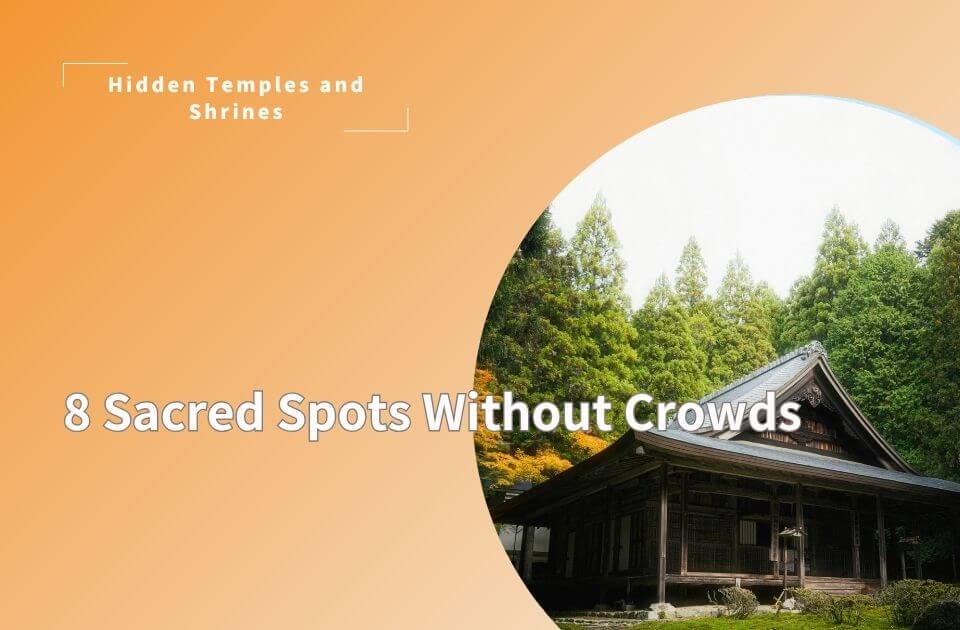
Last November, I stood alone in the moss garden of a temple in rural Shiga Prefecture. No other visitors, no audio guides, no tour buses. Just me, a thousand years of moss, and the sound of water dripping from stone into a basin. I had walked 20 minutes from the nearest bus stop through a forest to get there, and the only sign of the temple was a faded wooden post at a fork in the path. It was one of the most profoundly peaceful hours I have ever spent in Japan.
Japan has approximately 80,000 temples and 80,000 shrines. The famous ones, Kinkakuji, Fushimi Inari, Meiji Jingu, Senso-ji, are magnificent and absolutely worth visiting. But they are also swarmed with visitors. If you want to experience the spiritual quiet that these places were originally designed for, you need to go where the crowds do not. Here are eight sacred spots where you can actually hear yourself think.
1. Ohara Sanzenin, Kyoto (Not the Temple You Think)
Most Kyoto visitors never make it to Ohara, a small farming village about 45 minutes north of central Kyoto by bus. Sanzenin Temple here is technically “known,” but its location keeps the crowds manageable even during peak seasons. On a weekday morning, you might share the garden with five or six other people.
The Yusei-en garden is the showpiece: a carpet of deep green moss under a canopy of maples and cedar, dotted with small stone jizo statues wearing moss caps. In autumn, red maple leaves settle on the green moss, creating a natural color palette that no photographer can resist. In June, the hydrangeas bloom along the temple approach.
Admission is 700 yen. Take Kyoto Bus 17 from Kyoto Station to Ohara (about 60 minutes, 580 yen one way). The walk from the bus stop to the temple through the village, past pickled vegetable shops and small restaurants, is part of the charm. Shiba-zuke pickles are Ohara’s specialty; buy a bag (300 to 500 yen) from any of the roadside shops.
2. Yamadera (Risshakuji), Yamagata Prefecture
Yamadera appears in some guidebooks but rarely on actual tourist itineraries, because getting to Yamagata Prefecture requires deliberate effort. This temple complex, founded in 860, clings to a sheer mountain face, with buildings perched on rock ledges connected by 1,015 stone steps carved into the cliff.
The poet Matsuo Basho visited in 1689 and wrote his famous haiku here: “Shizukasa ya / iwa ni shimiiru / semi no koe” (Such stillness / seeping into the rocks / cicada voices). Over 300 years later, the stillness remains.
The climb takes 30 to 45 minutes and is moderately strenuous. At the top, the Godaido viewing platform offers a panoramic view of the valley below, with temple buildings emerging from the cliff face at various levels. In autumn, the mountain is ablaze with color. In winter, the stone steps under snow create an almost monastic atmosphere.
Admission is 300 yen. JR Senzan Line from Sendai (about 60 minutes) or Yamagata (about 20 minutes) to Yamadera Station. The temple is a 10-minute walk from the station.
3. Muro-ji, Nara Prefecture
While millions flock to Todaiji in central Nara, Muro-ji sits in the mountains of Uda, about 90 minutes from Nara City by train and bus. Known as the “women’s Koya-san” because it was one of the few major Buddhist temple complexes that admitted women when Koya-san still excluded them, Muro-ji has an atmosphere of deep forest spirituality.
The five-story pagoda, the smallest outdoor pagoda in Japan at just 16 meters tall, stands in a grove of towering cedar trees. The contrast of the vermillion pagoda against the dark green forest is startling. Stone steps lead higher into the mountain past moss-covered stone walls and halls that feel genuinely ancient.
In late April, the temple approach is lined with thousands of rhododendrons (shakunage) in pink, purple, and white. In November, autumn maples add another layer of color.
Admission is 600 yen. Take the Kintetsu Railway to Muroguchi Ono Station, then a bus to Muro-ji mae (about 15 minutes, 440 yen). On weekdays, you may be the only foreign visitor.
4. Taimadera, Nara Prefecture
Taimadera is one of Nara’s oldest temples, founded in 612, yet it receives a tiny fraction of the visitors that nearby Horyuji attracts. The temple is associated with Princess Chujo, who according to legend wove a magnificent mandala in a single night with lotus thread spun by Amida Buddha himself.
The twin pagodas (East and West) are both designated National Treasures and date from the Nara and Kamakura periods. The temple grounds are spacious and serene, with a pure lotus garden that blooms spectacularly in July and August.
Admission is 500 yen for the main hall complex. Taimadera Station on the Kintetsu Minami Osaka Line is a 15-minute walk from the temple. From Osaka’s Abenobashi Station, the trip takes about 40 minutes.
5. Daisho-in, Miyajima Island, Hiroshima
Every visitor to Miyajima walks straight to Itsukushima Shrine to see the floating torii gate. Daisho-in, the island’s most important actual temple, sits at the base of Mount Misen just a few minutes’ walk away, and most tourists walk right past the entrance without noticing.
The temple complex climbs the mountainside through a series of halls, gates, and gardens. A row of 500 Rakan statues (disciples of Buddha), each with a unique expression and many wearing hand-knitted caps, line one of the staircases. Visitors spin prayer wheels embedded in the railings as they climb. Mandalas, Buddhist statuary, and ritual objects fill the halls.
Daisho-in has a warmth and eccentricity that many famous temples lack. In the underground passage of the Henjokutsu Cave, you walk in near-darkness past 88 icons representing the 88 temples of the Shikoku pilgrimage, effectively completing a symbolic pilgrimage in five minutes.
Admission is free. From the Itsukushima Shrine area, walk south along the waterfront and up the stone steps. Allow 45 to 60 minutes to explore properly.
6. Kongobu-ji and Okunoin, Koyasan, Wakayama
Koyasan (Mount Koya) is not exactly unknown, but its remote mountaintop location filters out casual visitors. The temple town, founded in 816 by Kobo Daishi (Kukai), is the headquarters of Shingon Buddhism and home to over 100 temples.
Okunoin, the vast cemetery leading to Kobo Daishi’s mausoleum, is unlike anything else in Japan. A 2-kilometer path passes through a forest of 200,000 moss-covered tombstones and towering cedar trees, some over 600 years old. At the end, the Torodo (Hall of Lamps) houses over 10,000 lanterns that have burned continuously for centuries. Walking Okunoin at night, when the stone lanterns along the path are lit and the forest is silent, is one of the most atmospheric experiences in Japan.
Kongobu-ji, the head temple, has the largest rock garden in Japan (2,340 square meters), representing a pair of dragons emerging from clouds. Admission is 1,000 yen.
Stay overnight in a temple lodging (shukubo) to experience morning chanting and Buddhist vegetarian cuisine (shojin ryori). Rates start around 12,000 yen per person including dinner and breakfast. Eko-in and Shojoshin-in are popular choices with English-friendly staff.
Access: Nankai Railway from Osaka Namba to Gokurakubashi (about 90 minutes), then cable car to Koyasan (5 minutes, included in combined tickets from about 2,900 yen one way from Namba).
7. Zeniarai Benten, Kamakura
Kamakura has famous temples aplenty, but Zeniarai Benten Shrine is tucked into a hidden cave in the hills behind the Great Buddha. The approach requires walking through a tunnel carved into the rock face and emerging into a small valley surrounded by cliffs.
The shrine is dedicated to wealth, and the main ritual involves washing your money in the spring water inside the cave. Legend says money washed here will multiply. You place your coins (or bills, in a provided basket) in the spring, let the water flow over them, and then spend the “blessed” money to activate the luck. It is charmingly pragmatic: you have to spend the money for the luck to work.
The shrine is free. Reaching it requires a 25-minute walk from Kamakura Station through residential streets and up a steep hill. The lack of convenient access keeps the crowds thin. On a weekday, the cave spring area is often empty.
8. Eiheiji, Fukui Prefecture
Eiheiji is one of the two head temples of Soto Zen Buddhism, founded in 1244 by Dogen Zenji. The temple complex sprawls across a forested mountainside, with 70 buildings connected by covered corridors that wind through towering cedar trees. About 150 monks live and train here year-round in one of the most rigorous monastic programs in Japanese Buddhism.
Visiting Eiheiji feels fundamentally different from visiting a “tourist temple.” The monks’ daily schedule governs the pace of the complex. Corridors are polished to a mirror shine by monks who clean them on hands and knees every morning. The silence is not curated for visitors; it is the actual silence of a functioning monastery.
Admission is 500 yen. The temple offers overnight Zen training experiences (sanro taiken) for visitors who want to experience the monastic routine: waking at 3:30 AM, sitting zazen (meditation), eating formal meals in silence, and cleaning. The program costs about 10,000 yen and requires advance reservation. Even if you do not stay overnight, spending a few hours walking the corridors and sitting quietly in the meditation hall is worth the trip.
Access: Eiheiji-guchi Station on the Echizen Railway from Fukui City (about 25 minutes), then bus to the temple (about 15 minutes, 440 yen).
Tips for Visiting Quiet Temples and Shrines
Timing: Early morning (before 9 AM) and late afternoon (after 3 PM) are almost always quieter, even at famous temples. Many temples open at 8 or 8:30 AM.
Weekdays over weekends: The difference is dramatic, especially at temples outside major cities.
Seasons: If you want solitude, avoid peak cherry blossom (late March to mid-April) and peak autumn (mid to late November in Kansai). January through March and June are the quietest months at most temples.
Etiquette: Speak quietly. Bow at torii gates and temple entrances. Do not photograph people praying. Follow posted photography rules. Leave the space as you found it.
The temple that changes you will not be the most famous or the most photographed. It will be the one where you had the space to actually be present: where the only sound was wind through bamboo, where the moss was so green it looked painted, where you sat on a wooden veranda and forgot about your phone for an hour. These eight places offer that. Go find the one that speaks to you.
Follow Japan is your insider guide to experiencing Japan like a local. Follow @followjapan_fj on Instagram for daily Japan travel tips and hidden gems.


