
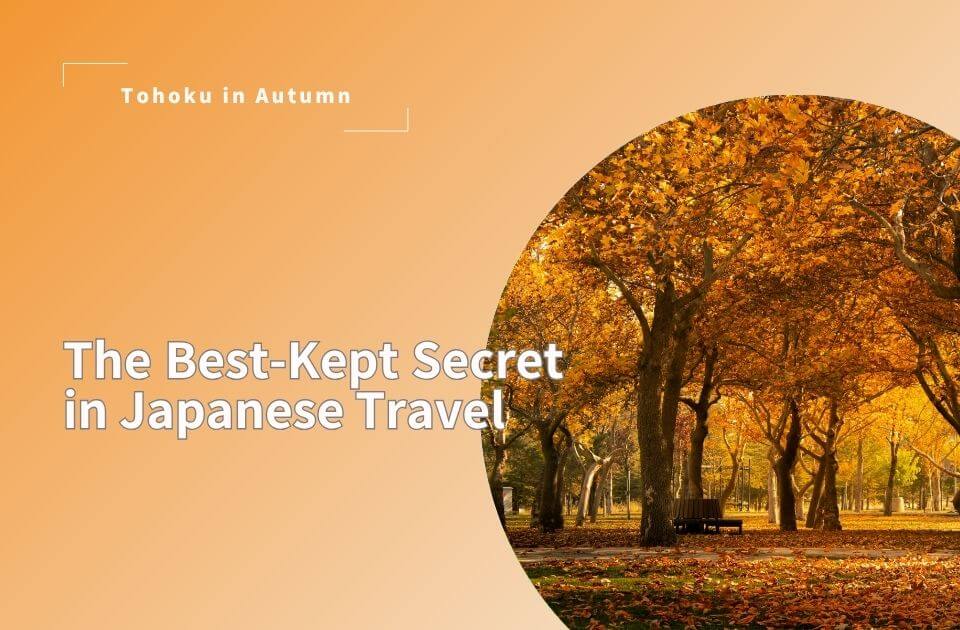
I almost did not go to Tohoku in autumn. A friend in Tokyo had told me, “You already live near Kyoto. Why would you go all the way up north for fall colors?” I went anyway, on a whim, with a one-way Shinkansen ticket to Sendai and a rental car booked for five days. What I found was the most stunning autumn landscape I have seen in Japan, possibly anywhere. And I had it almost entirely to myself.
Tohoku, the six prefectures of northern Honshu (Aomori, Akita, Iwate, Miyagi, Yamagata, and Fukushima), is consistently overlooked by international visitors who rush between Tokyo, Kyoto, and Osaka. During autumn, when Kyoto’s temples are shoulder-to-shoulder with visitors and hotel prices triple, Tohoku’s mountains, gorges, and onsen towns are draped in the same spectacular colors with a fraction of the crowds and at half the price. This is Japan’s best-kept travel secret, and I am going to spill it.
Why Tohoku Peaks Earlier (And Why That Is Perfect)
Tohoku’s autumn colors begin in late September at high elevations and work their way down to the valleys and coast through late October and early November. This means Tohoku’s peak is roughly two to four weeks ahead of Kyoto and Tokyo. If you visit in the first half of October, you hit Tohoku at peak color and can still catch the beginning of autumn in the Kanto and Kansai regions as you head south.
The region’s latitude and mountain terrain create a broader palette than southern Japan. While Kyoto’s autumn is primarily red and orange (dominated by Japanese maples), Tohoku’s forests include beech, oak, birch, and maple, producing a spectrum that ranges from deep crimson through burnt orange, gold, and pale yellow. The mountains look like they have been painted.
Naruko Gorge, Miyagi: The Masterpiece
If I could show one autumn scene to convince someone to visit Tohoku, it would be Naruko Gorge (Naruko-kyo). This 2.5-kilometer ravine, carved by the Oya River, features vertical cliff faces covered in a patchwork of red, orange, yellow, and green that looks almost artificial in its intensity. Peak color is usually mid to late October.
A walking trail runs along the gorge from the Naruko-kyo rest house to Nakayamadaira Onsen Station. The full walk takes about an hour and the views change constantly. The Ofukazawa Bridge, about midway, offers the most photographed vantage point. On a clear October morning, the gorge is so colorful it almost hurts your eyes.
Access is free. Take the JR Rikuu East Line from Sendai to Naruko Onsen Station (about 90 minutes, 1,170 yen), then a short bus or 15-minute walk to the trailhead.
While you are in the area, Naruko Onsen itself is a charming hot spring town with nine different water types (the most variety of any single onsen area in Japan). Takianoyu (1,100 yen) has a stunning milky blue sulfur bath. Taki no Yu in the town center is a free public foot bath perfect for warming up after the gorge walk.
Hakkoda Mountains, Aomori: Fire on the Peaks
The Hakkoda Mountains south of Aomori City are among the first places in Tohoku to turn. The Hakkoda Ropeway (2,000 yen round trip) carries you above the treeline in about 10 minutes, offering aerial views of the mountain slopes in full autumn color. Peak is early to mid-October at the summit, spreading down the slopes through late October.
From the upper station, several hiking trails fan out through the marshlands and peaks. The Kenashitai Marsh Circuit is an easy 30-minute boardwalk loop through alpine wetlands surrounded by blazing autumn forest. For a longer hike, the trail to Odake Peak (about 90 minutes round trip) rewards with panoramic views of the Hakkoda range and, on clear days, the Tsugaru Strait and Hokkaido beyond.
Nearby Sukayu Onsen is one of Tohoku’s most legendary hot springs. Their Hiba Sennin Buro (Thousand Person Bath) is a massive mixed-gender wooden bathhouse that can accommodate, well, not actually 1,000 people, but it is enormous. Day use is 1,000 yen. The milky, acidic sulfur water is therapeutic and the atmosphere inside the ancient wooden building is something you will not find anywhere else.
Oirase Stream, Aomori: The Perfect Walk
Oirase Stream (Oirase Keiryu) is a 14-kilometer mountain stream that flows from Lake Towada through beech and maple forest. A flat, paved walking trail follows the stream past waterfalls, moss-covered boulders, and pools of impossibly clear water. In autumn, the canopy over the trail becomes a tunnel of gold and red.
Peak color is usually late October. The most scenic section is the 3-kilometer stretch between Kumoi no Taki (Cloud Falls) and Choshi Otaki (the main waterfall at the stream’s end). You can walk the entire 14 kilometers in about four to five hours, or bus to a midpoint and walk a shorter section. JR buses run along the road parallel to the stream (Aomori Station to Lake Towada, about 2.5 hours).
The combination of water, forest, and autumn light here is extraordinary. I have photographed autumn in dozens of locations across Japan, and Oirase is the one I keep returning to.
Dakigaeri Gorge, Akita: Turquoise and Crimson
Dakigaeri Gorge near Kakunodate in Akita Prefecture is named for its narrowness: historically, people passing on the trail had to embrace (dakigaeri) to squeeze past each other. The gorge features a surreal combination of deep turquoise river water and crimson autumn foliage that creates a color contrast unlike anything I have seen elsewhere.
The Kamiiwai Bridge, a striking red suspension bridge early in the trail, is the classic photo spot, with turquoise water below and red maples above. The walking trail (about 30 minutes each way to the main viewing points) is easy and free. Peak color is late October to early November.
Combine Dakigaeri with the nearby samurai district of Kakunodate, where a 600-meter avenue of weeping cherry trees turns golden in autumn. The samurai houses (several open for free or 300 to 500 yen) are beautifully preserved and far less crowded than similar historical areas elsewhere in Japan.
Yamadera, Yamagata: The Mountain Temple
Yamadera (formally Risshakuji Temple) is a collection of temple buildings clinging to a sheer mountain face. The 1,015 stone steps to the summit platform, the Godaido, are flanked by ancient cedar and maple trees. In autumn, the climb is a journey through a vertical forest of color, and the view from the top, overlooking the valley with autumn mountains stretching to the horizon, is one of the finest in Tohoku.
Admission is 300 yen. The climb takes about 30 to 45 minutes at a steady pace. Yamadera Station is on the JR Senzan Line, about 60 minutes from Yamagata City or 90 minutes from Sendai.
After the climb, warm up at the foot of the mountain with Yamagata’s famous imoni (taro potato stew). Every autumn, the Yamagata Imoni Festival (held in September along the Mamigasaki River) cooks imoni in a pot six meters across using a backhoe as a ladle. Even outside the festival, restaurants near Yamadera serve excellent imoni for 600 to 800 yen per bowl.
Ginzan Onsen, Yamagata: Step Into a Photograph
Ginzan Onsen is a tiny hot spring town in a narrow valley, with wooden ryokan buildings lining both sides of a river, gas lamps illuminating the stone bridges, and steam rising from the baths. It looks like a scene from a Ghibli film. In autumn, the surrounding mountains frame the town in red and gold. In early winter, snow turns it into something from a dream.
Peak autumn at Ginzan Onsen is late October to early November. Staying overnight is the ideal experience but difficult to book; the town has only about 13 ryokan, and some, like the famous Notoya Ryokan, book out months ahead. Rates range from 15,000 to 40,000 yen per person with dinner and breakfast. Day visitors can walk the town freely and use some public baths (Shirogane no Yu, 500 yen).
Access: bus from Oishida Station on the JR Yamagata Shinkansen (about 40 minutes, free shuttle buses are offered by some ryokan).
Planning a Tohoku Autumn Trip
Best timing: First two weeks of October for mountains and gorges. Last two weeks of October for lower elevations, towns, and onsen areas. Early November for the southern edges of the region.
Transportation: The JR East Pass (Tohoku Area) costs 30,000 yen for five flexible days and covers all JR trains including Shinkansen in the Tohoku region. For the gorges and mountain areas, a rental car gives you much more flexibility. Compact cars from Sendai Station start around 5,000 yen per day.
Accommodation: Tohoku’s ryokan and onsen hotels are significantly cheaper than comparable places in Kyoto. A night in a proper ryokan with dinner and breakfast runs 12,000 to 20,000 yen per person in Tohoku, versus 25,000 to 50,000 yen in Kyoto during peak autumn.
Food: Tohoku is an underrated food region. Sendai’s gyutan (beef tongue, sets from 1,500 yen), Yamagata’s imoni, Akita’s kiritanpo (pounded rice sticks in chicken broth), Morioka’s wanko soba (all-you-can-eat buckwheat noodles, about 3,500 yen), and Aomori’s apple everything.
Crowds: This is the key advantage. On a weekday in mid-October, I walked the entire Oirase Stream trail and passed perhaps 30 people. At the same moment, Tofukuji in Kyoto had an estimated 15,000 daily visitors. The difference is not subtle.
Tohoku in autumn is Japan as it was before the tourist boom: spectacular, affordable, genuine, and quiet. The mountains are on fire, the onsen are steaming, and the ryokan have rooms available. Put it on your list. Go this October. You can save Kyoto for another trip.
Follow Japan is your insider guide to experiencing Japan like a local. Follow @followjapan_fj on Instagram for daily Japan travel tips and hidden gems.


