
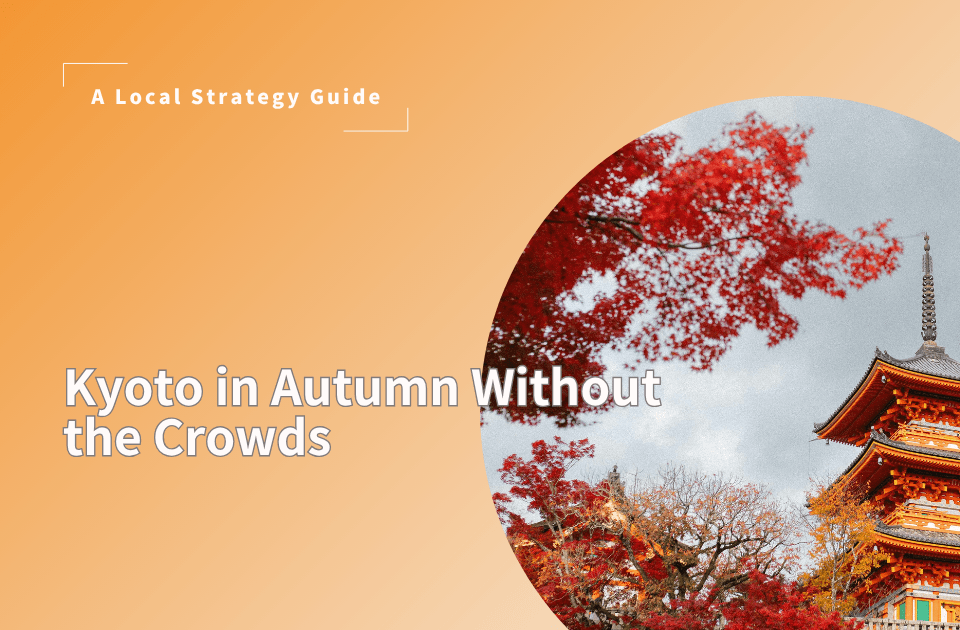
Last November I watched a tour group leader hold a flag above her head at Kiyomizu-dera at 11am, trying to keep forty people together in a crowd so dense that nobody could stop walking even if they wanted to. Twenty minutes earlier and two kilometers away, I had been standing completely alone in a temple garden carpeted in red maple leaves, listening to a bamboo water spout knock against stone. Same city, same morning, same peak foliage. The difference was not luck. Kyoto in autumn is entirely survivable, even wonderful, if you understand how the crowds move and refuse to move with them. Here is the local playbook for 2026.
Know When the Crowds Peak, Down to the Hour
First, the calendar. Kyoto’s foliage window in 2026 will likely run from around November 20 through December 7, with recent warm autumns pushing the best color later than the guidebooks admit. The single most crowded stretch of the entire season will be the long weekend around Labor Thanksgiving Day, November 21-23. Domestic tourism floods the city on those dates on top of the international crowds. If your dates are flexible, aim for the last week of November into the first week of December instead: the color is often still superb and the pressure drops noticeably, especially on weekdays.
Second, the clock. Kyoto’s tourist wave is astonishingly predictable. It builds from 9:30am, peaks between 11am and 3pm, and collapses after 4pm. The famous temples open at 8:30 or 9:00am, and for the first hour they are a different world. My standing rule for autumn: two temples before 10am, then leave the marquee sights entirely and spend midday somewhere the buses do not go, then return for evening illuminations. You see more, photograph better, and stay sane.
The Hidden Temples That Deliver
Everyone goes to Kiyomizu-dera, Tofukuji, and Arashiyama’s main street. Nobody needs to tell you about those. Here is where I send friends instead, all of them genuinely quiet even in late November.
Honen-in, just off the Philosopher’s Path, is the best five-minute detour in eastern Kyoto. The thatched gate framing raked sand mounds under maples is one of the city’s iconic autumn images, the grounds are free, and it stays calm while Ginkakuji up the road heaves. Sennyu-ji and its sub-temple Unryu-in, in the southeast, sit in a fold of the hills that tour itineraries simply skip; Unryu-in’s round window framing autumn color is famous in Japanese photo circles and almost unknown outside them. Nisonin in the quieter back half of Arashiyama has a maple-lined approach path that rivals anything in the district, a fraction of the crowd, and takes under an hour. Koetsu-ji in Takagamine, in the northwest, pairs beautifully with nearby Genkoan and its “window of enlightenment,” and the whole area feels like a village. And Taizo-in, a sub-temple inside the vast Myoshin-ji zen complex, offers a superb landscaped garden where I have sat entirely alone on peak-season weekdays.
The pattern worth learning: Kyoto’s headline temples are single names, but the city is actually a network of huge temple complexes full of sub-temples, many with spectacular small gardens and admission of 500-600 yen. The complexes absorb people; the sub-temples stay empty.
Leave the City Center at Midday
Midday is when central Kyoto is worst, so use it for the valley towns. Ohara, an hour north by bus, is a farming valley whose temple Sanzen-in sits in cedar forest with moss gardens that look best precisely when fallen leaves scatter across them. Kibune and Kurama, reached by the charming Eizan railway (which runs through a literal tunnel of maple trees, lit at night in season), offer a mountain-shrine walk between two villages. Uji, twenty minutes south by train, pairs Byodo-in temple, the building on the 10-yen coin, with the best matcha desserts in the country. All three swallow an afternoon happily, and all three are calmer than any central sight at 1pm.
Transport tactics matter as much as destinations. In late November, avoid the city buses along the eastern sightseeing corridor; they are standing-room crushes stuck in traffic. The subway, the JR lines, the Keihan line, and your own feet are faster and infinitely more pleasant. From Kyoto Station to Tofukuji is one train stop; to the eastern temples, take the subway to Higashiyama or Keage and walk. Renting a bicycle is also seriously underrated in autumn: the city is flat, and the Kamo river path is its own foliage spot.
Eating Well When the City Is Full
Restaurant crowding is the part of peak-season Kyoto nobody warns you about. The famous lunch spots near the eastern temples run 90-minute waits in late November, and dinner without a reservation in Gion becomes a walking tour of “full tonight” signs. The fixes are simple. Eat lunch early or late: at 11am or 2:30pm you walk into places that are impossible at noon. Eat where the offices are, not where the temples are; the business-lunch neighborhoods around Karasuma and Shijo, and the food floors of the station building, serve excellent food with normal wait times. Book dinner ahead for any night in the peak window, even casual places, most of which now take online reservations. And embrace the market-and-bench picnic: Nishiki Market skewers or a depachika bento eaten along the Kamo river at sunset beats a mediocre tourist-strip dinner by miles. One more local secret: the temples themselves often have superb, calm eating attached. Shigetsu, the Zen vegetarian restaurant inside Tenryu-ji’s grounds, and the yudofu (simmered tofu) houses around Nanzenji serve seasonal meals in garden settings, and lunch there is part of the sightseeing, not a break from it.
Evening Illuminations: The Second Shift
During peak season, a dozen or more temples run nighttime light-ups, typically 5:30 to 9pm with separate admission around 600-1,000 yen. Kodai-ji’s reflection pond, Eikando’s lit pagoda, and the bamboo-and-maple grounds of Entoku-in are the famous ones. The strategy: illuminations effectively give you a second sightseeing day after dinner, and the last entry hour, after 8pm, is dramatically quieter than the 6pm rush. Dress warmly, since standing in a November garden at night is genuinely cold, and note that tripods are banned almost everywhere, so learn your phone’s night mode before you come.
Actionable Game Plan
Here is a model peak-season day that works: 8:30am at one headline temple (pick one, book nothing else against it), 10am walk to a nearby sub-temple or Honen-in, 11:30am train out to Ohara or Uji for lunch and the afternoon, 5pm back into the city for dinner in a neighborhood away from the sights, 8pm final-hour entry at an illumination. You will have seen five or six places at their best while the crowd saw two at their worst.
Quick tips:
・The 2026 sweet spot is likely November 20 to December 7; late beats early if you must choose
・Avoid the November 21-23 holiday weekend or accept what it brings
・Two temples before 10am, valley towns at midday, illuminations at night
・Skip the eastern corridor buses; use trains, subway, and your feet
・Fallen leaves photograph better than peak leaves at moss gardens, so early December has its own rewards
Kyoto in autumn deserves its reputation, crowds and all. Move against the current and you get the version of the city that made that reputation in the first place.
For more Kyoto-insider guides, follow @followjapan_fj on Instagram.


