
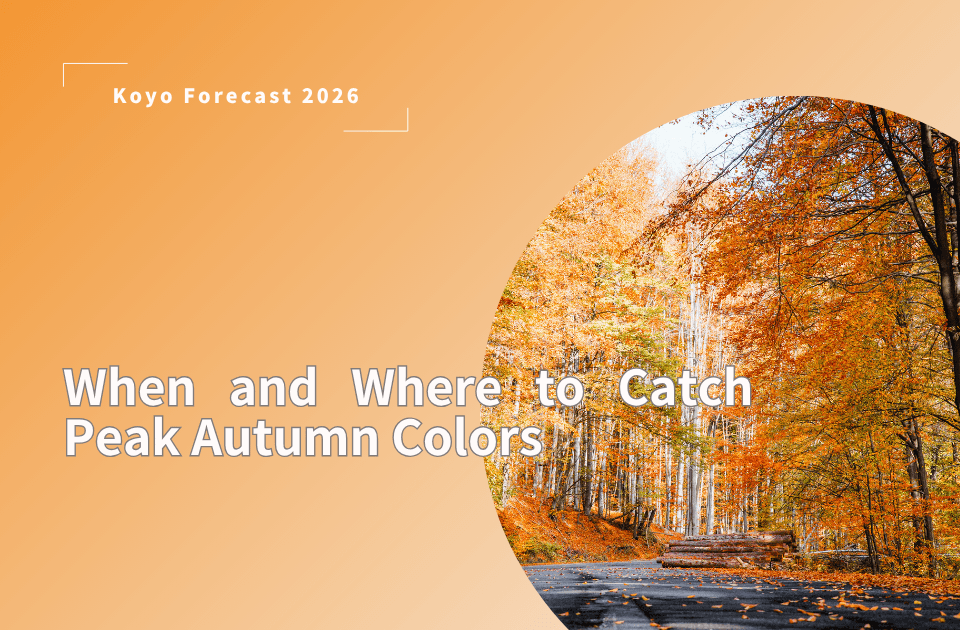
Every September, my inbox fills up with the same question from friends planning trips: “When exactly do the leaves change?” And every year I give the same slightly annoying answer: it depends on where you are standing. Japan’s autumn colors are not one event. They are a slow-motion wave that starts on Hokkaido’s mountaintops in September and does not finish until early December in the southern cities. Time it right and you get the most beautiful landscapes this country produces. Time it wrong and you are standing under stubbornly green trees wondering what the fuss is about. Here is how the 2026 koyo season is shaping up, and how to actually plan around it.
How the Koyo Front Works
Japanese media tracks the “koyo front” (autumn foliage front) the same way it tracks cherry blossoms in spring, just in reverse. Color starts at high elevations in the north and rolls south and downhill over about ten weeks. Two rules of thumb cover almost everything: the further north you are, the earlier the color arrives, and every gain in altitude bumps the schedule earlier too. A mountain pass at 2,000 meters can be at fiery peak while the city at its base, an hour away by bus, is still fully green.
One important note for 2026: recent warm autumns have consistently pushed peak color in the big lowland cities later than the old guidebook dates. Tokyo and Kyoto, which once peaked reliably in mid November, now often hit their best color in late November and can run into the first week of December. The Japan Meteorological Corporation and other forecasters publish their first official predictions in early September, with updates every couple of weeks through the season, so treat everything you read before then, including this article, as an educated forecast rather than a promise. The mechanics behind the timing are simple: maples need cool nights, ideally dipping below 8 degrees Celsius, to trigger the color change, and a string of sunny days after that to develop the deep reds.
The 2026 Timeline, Region by Region
Mid September to early October: Hokkaido’s high country. Daisetsuzan National Park is the first place in Japan to turn, every single year. The alpine slopes around Asahidake and Kurodake go red and gold while the rest of the country is still running air conditioners. The Asahidake Ropeway takes you straight into the color zone, and the contrast of crimson leaves against early-season snow dustings is something you simply cannot see anywhere else in September. Jozankei, the onsen valley an hour from Sapporo, follows in early to mid October and makes a far easier target if you are basing in the city.
Late October to early November: Tohoku and the mountains. This is when the famous stream at Oirase Gorge in Aomori hits peak, and it is genuinely worth the trek: a 14-kilometer walking path along a mossy river, canopied in gold. Lake Towada sits at the top of the gorge for a two-in-one trip. The Japanese Alps around Kamikochi, Nikko’s higher elevations around Lake Chuzenji, and Hakone’s upper slopes all peak in this same window. This is, in my opinion, the sweet spot of the whole season: the scenery is spectacular and the city crowds have not fully mobilized yet.
Early to mid November: the foothills. Kawaguchiko at the base of Mt. Fuji usually peaks in early to mid November, and the maple corridor along the lake’s north shore, with Fuji floating in the background, is one of the most photographed autumn scenes in Japan for good reason. Korankei Gorge near Nagoya, with its 4,000 maples and nightly illumination, also peaks in this window and deserves far more international attention than it gets.
Mid November to early December: the cities. Tokyo, Kyoto, Nara, and Osaka come last. For Kyoto in 2026, the safest planning window is roughly November 20 through December 7, with the possibility of good color lingering even later if the autumn runs warm. Tokyo’s gingko avenues, like the famous one at Meiji Jingu Gaien, tend to go full gold in late November, and the garden light-ups at places like Rikugien run into early December.
Insider Timing Tricks
The single best strategy I know: build your trip around one region, not the whole country. Trying to catch peak color in both Hokkaido and Kyoto on one two-week trip means fighting the calendar, because they peak six weeks apart. Instead, pick your dates first, then aim at whichever region will be peaking when you are here. Traveling in mid October? Head north or head uphill. Late November? The cities will meet you where you are.
If your dates are fixed and the color has not arrived yet, use elevation as your remote control. Ropeways are your best friend in the shoulder weeks. Hakone’s ropeway network, the Tateyama Kurobe Alpine Route, and Nikko’s Akechidaira Ropeway all let you ride up a mountainside to whatever altitude is currently peaking. I have salvaged more than one “too early” trip this way.
Also, do not sleep on the tail end of the season. Late November and early December in Kyoto means thinner crowds than the peak weekend rush, plus a bonus most first-timers never consider: fallen-leaf carpets. The moss gardens and stone paths of temples like those in the Ohara valley arguably look better under a red carpet of fallen momiji than they do with the leaves still on the trees. Photographers know this. Tour groups do not.
One more trick: night illuminations effectively double your sightseeing day. Many Kyoto temples and gardens run evening light-ups during peak season, with separate admission from daytime. The reflection ponds at these events produce the single most dramatic photos of the season, and evening slots eat less of your prime daytime itinerary.
Practical Recommendations
Book accommodation for the November peak in Kyoto and Nikko as early as you can. These are the two most crowded foliage destinations in the country, and the good mid-range places sell out months ahead. Weekdays beat weekends by a huge margin. The November 21-23 holiday weekend in 2026, anchored by Labor Thanksgiving Day, will be the single busiest stretch of the entire season nationwide. If you can only avoid one thing, avoid that.
Build margin into your plans. Peak color at any single spot lasts roughly 7 to 10 days, but one typhoon-remnant rainstorm can strip half the leaves overnight in the late season. Front-load your must-see locations at the start of your trip and keep a flexible day in reserve.
What to Wear and How to Move
Autumn in Japan spans a huge temperature range, and foliage chasing makes it wider. A late-October day can mean 18 degrees and sunshine in Tokyo, 8 degrees at Lake Chuzenji, and near-freezing at the top of a ropeway. Layers are not optional. I do every foliage trip with a packable down jacket stuffed in a daypack, worn over a t-shirt in the city and deployed the moment the bus starts climbing. Add gloves for anything alpine after mid October, and wear real walking shoes: the best viewing spots, from Oirase’s riverside path to Kyoto’s temple staircases, all involve more walking on damp stone and gravel than you expect.
For transport, foliage season is when Japan’s rail passes and regional bus passes earn their keep. The mountain destinations that peak earliest, like Nikko and Hakone, both sell excellent-value area passes from their gateway stations that bundle the buses, boats, and ropeways you will actually use. Book limited express train seats in advance for peak November weekends, especially the Nikko-bound trains from Tokyo on Saturday mornings, which sell out. And if you are renting a car for somewhere like Oirase or Towada, reserve it weeks ahead; rural rental fleets are small and foliage season is their Super Bowl.
Quick tips:
・Check the official koyo forecast when it drops in September, then re-check two weeks before you fly
・Cool nights plus sunny days produce the best reds, so a cold snap is good news for your photos
・Rain knocks leaves down fast at the end of the season, so see your top spots early in the trip
・Morning light through red maples beats midday light every time, and you get the temples to yourself
・If you miss peak in the city, ride a ropeway or train uphill and you can travel back in time a week
The wave is coming. Plan around it, not against it, and 2026 could hand you the best autumn trip of your life.
For daily Japan travel tips and seasonal updates, follow @followjapan_fj on Instagram.


