
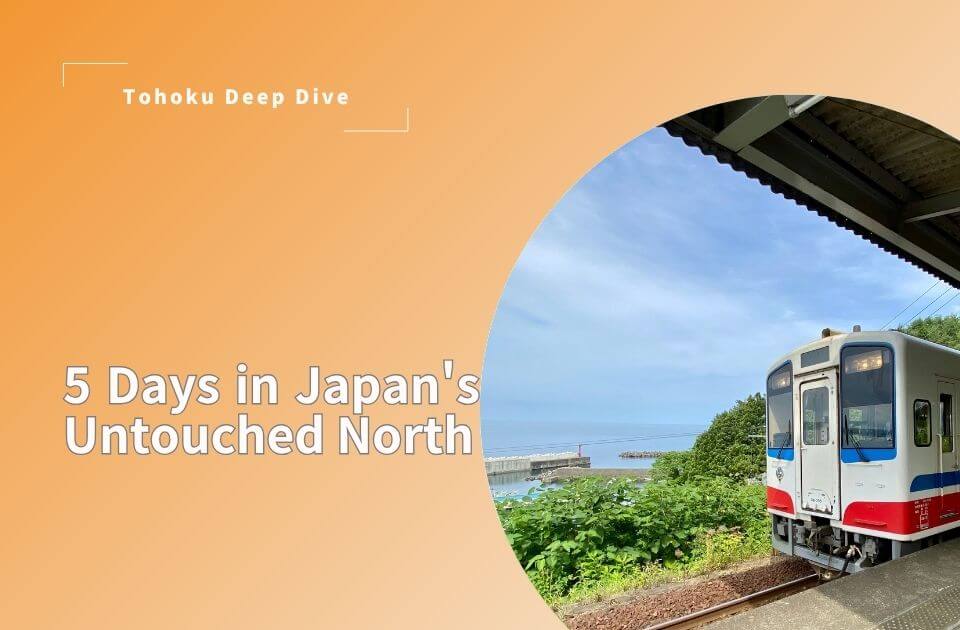
Most foreign visitors to Japan follow a well-worn path: Tokyo, Kyoto, Osaka, maybe Hiroshima. The north barely registers. Tohoku, the six prefectures that make up the northern third of Honshu, is one of the least visited regions by international travelers, and that is precisely why you should go.
I first went to Tohoku almost by accident, chasing a festival recommendation from a coworker. I came back three more times in the following two years. The region has rugged coastlines, volcanic mountain ranges, some of the best hot springs in Japan, and a food culture that quietly rivals anything in Kansai. It also has a pace of life that feels like Japan from 30 years ago, before overtourism became a talking point.
Here is a five-day itinerary through Tohoku that hits the highlights without turning it into a marathon. You will need a Japan Rail Pass or a JR East Tohoku Area Pass (about 20,000 yen for five flexible days) to make this work efficiently.
Day 1: Sendai, the Gateway
Take the Tohoku Shinkansen from Tokyo Station. You will be in Sendai in about 90 minutes, which still amazes me every time. Sendai is a city of about a million people, and it functions as the cultural capital of Tohoku. It is big enough to have everything you need but relaxed enough that it never feels overwhelming.
Drop your bags at your hotel. I recommend the area around Sendai Station for convenience. The Hotel Metropolitan Sendai is right at the station and runs about 10,000 to 15,000 yen per night, or for budget travelers, the Dormy Inn Sendai Ekimae (about 7,000 yen) has a rooftop onsen that is hard to beat at the price point.
Head straight to Sendai’s Jozenji-dori Avenue, a beautiful tree-lined boulevard about a 10-minute walk from the station. The zelkova trees form a green tunnel in summer, and the median walking path is lined with sculptures and benches. It is one of my favorite urban streets in Japan.
For lunch, you must eat gyutan, which is grilled beef tongue and Sendai’s signature dish. I know the concept might be off-putting, but trust me. Rikyu is the most famous chain, with a location near the station, and their set meal with thick-cut gyutan, barley rice, tail soup, and pickles costs about 1,800 to 2,000 yen. The meat is tender, smoky, and addictive. If Rikyu has a line, Kisuke is an equally excellent alternative.
In the afternoon, visit the ruins of Sendai Castle (Aoba Castle) on a hill overlooking the city. The castle itself is gone, but the site has a museum and an iconic statue of Date Masamune, the one-eyed feudal lord who founded Sendai. The view over the city is excellent and entry to the grounds is free.
For dinner, explore the Kokubuncho entertainment district, which is Tohoku’s largest nightlife area. It is not sleazy, just lively, with hundreds of izakaya, bars, and restaurants. Find a small place serving local Miyagi seafood. The oysters from Matsushima Bay are some of the best in Japan.
Day 2: Matsushima and Yamadera
Today requires an early start, but it covers two of Tohoku’s most iconic sights.
Take the JR Senseki Line from Sendai to Matsushima-Kaigan Station (about 40 minutes, covered by rail pass). Matsushima Bay, dotted with about 260 pine-covered islands, is considered one of Japan’s three most scenic views. Even the famously poetic Matsuo Basho was reportedly so overwhelmed when he visited that he could not write a proper haiku.
Take a boat cruise through the islands. The standard cruise loop takes about 50 minutes and costs 1,500 yen (1,350 yen with a Japan Rail Pass discount on some routes). The views from the deck are genuinely stunning on a clear morning. Back on shore, visit Zuiganji Temple (700 yen admission), one of Tohoku’s most important Zen temples, with elaborate wooden carvings and peaceful gardens.
Grab a grilled oyster or two from the stalls near the waterfront. Three oysters cost about 500 yen, and they are plump and fresh from the bay.
In the afternoon, head back to Sendai and transfer to the JR Senzan Line toward Yamagata. Get off at Yamadera Station (about 60 minutes from Sendai). Yamadera, formally called Risshakuji, is a mountain temple complex where over 1,000 stone steps climb up a cliff face through ancient cedar trees. It sounds exhausting, and your legs will confirm that, but the view from the top is one of those moments in Japan that makes you stop talking and just stare.
Admission is 300 yen. The climb takes 30 to 45 minutes at a comfortable pace. Basho visited here too and wrote his famous poem about the silence of cicadas seeping into the rocks. You will understand when you are up there.
Return to Sendai for the night, or if you prefer, stay in Yamagata City (about 20 minutes past Yamadera) and try the local dish: cold ramen, called hiyashi ramen, which Yamagata invented. Sakaeya Honten in central Yamagata serves a classic version for about 900 yen.
Day 3: Ginzan Onsen
This is the day that will produce your best photos and your deepest sense of having discovered something special. Ginzan Onsen is a tiny hot spring town tucked into a mountain valley in Yamagata Prefecture, and it looks like a scene from a Studio Ghibli film. Wooden ryokan with gas lamp-style lights line both sides of a narrow river, and in any season, the atmosphere is dreamlike.
Getting there takes some effort. From Sendai or Yamagata, take the Yamagata Shinkansen to Oishida Station (about 35 minutes from Yamagata). From Oishida, a local bus runs to Ginzan Onsen in about 40 minutes (about 730 yen). The bus runs only a few times a day, so check the schedule in advance.
The town is small enough to walk end to end in 15 minutes. The main activity is soaking in onsen. If you are not staying overnight, some ryokan offer day bathing. Shirogane-yu, a public bathhouse at the end of the main street, charges about 500 yen for entry and has both indoor and semi-outdoor baths.
If you can afford it, staying overnight at one of the ryokan is unforgettable. Notoya Ryokan and Fujiya Ryokan are the most famous, with rates starting around 20,000 to 30,000 yen per person including dinner and breakfast. Dinner will be a multi-course kaiseki meal featuring local mountain vegetables, river fish, and Yamagata beef, which is seriously underrated compared to more famous wagyu brands.
The evening atmosphere, when the gas lamps are lit and steam rises from the river, is the reason you came to Tohoku.
Day 4: Kakunodate and Lake Tazawa
From Yamagata, take the Yamagata Shinkansen north to Shinjo, then transfer to the Akita Shinkansen toward Akita. Get off at Kakunodate Station (total travel time about 2 to 2.5 hours depending on connections).
Kakunodate is known as the “little Kyoto of Tohoku” for its preserved samurai district. The comparison is a stretch, honestly, because Kakunodate has its own distinct character that does not need the Kyoto label. The samurai residences along Bukeyashiki-dori are lined with weeping cherry trees and black-walled compounds that you can enter, some for free and others for about 300 to 500 yen.
The Aoyagi Samurai Manor Museum (500 yen) is the most comprehensive, with multiple buildings displaying armor, weapons, and household items from the feudal era. The Ishiguro Residence (400 yen) is more intimate and gives a better sense of how samurai families actually lived.
After exploring Kakunodate, take a local bus or rent a car to Lake Tazawa, about 30 minutes away. Tazawako is Japan’s deepest lake at 423 meters, and its water is a vivid cobalt blue that looks photoshopped but is not. The golden statue of Tatsuko on the shore is a popular photo spot, and in summer you can swim or kayak in the lake. Kayak rentals run about 2,000 to 3,000 yen per hour.
Spend the night in the Tazawako area. There are several onsen hotels near the lake, with Taenoyu being a popular choice at about 12,000 to 18,000 yen per person with meals.
Day 5: Akita and Departure
From Tazawako, take the Akita Shinkansen to Akita City (about 45 minutes). Akita is a quiet prefectural capital with great food and a manageable size.
Visit the Akita Museum of Art (1,200 yen), which houses a massive painting by Leonard Foujita called “Events in Akita” that is 3.6 meters tall and 20 meters wide. Even if you are not an art person, the scale of it is striking.
For lunch, eat kiritanpo nabe, Akita’s signature dish of pounded rice tubes cooked in a chicken broth hot pot with vegetables and mushrooms. Suginoya in central Akita serves an excellent version for about 1,500 to 2,000 yen per person. Alternatively, try inaniwa udon, a delicate thin wheat noodle that is Akita’s answer to sanuki udon. Sato Yosuke near Akita Station serves it for about 800 to 1,200 yen.
From Akita, the Komachi Shinkansen takes you back to Tokyo in about four hours. Settle into your seat, watch the rice paddies and mountains scroll past the window, and process what you just experienced.
Why Tohoku Matters
I am not going to pretend that Tohoku is convenient. It requires more planning than the Tokyo-Kyoto-Osaka corridor, and some of the best spots involve bus transfers and limited schedules. But the reward is an encounter with a Japan that most visitors never see: quieter, more rugged, more generous. The people in Tohoku are notably warm, perhaps because they do not deal with tourist fatigue the way Kyoto does. You will be welcomed, and you will remember it.
Go to Tohoku. Take the slow roads. Eat the local food. Soak in the remote onsen. This is Japan with the volume turned down and the depth turned way up.
Follow Japan is your insider guide to experiencing Japan like a local. Follow @followjapan_fj on Instagram for daily Japan travel tips and hidden gems.


