
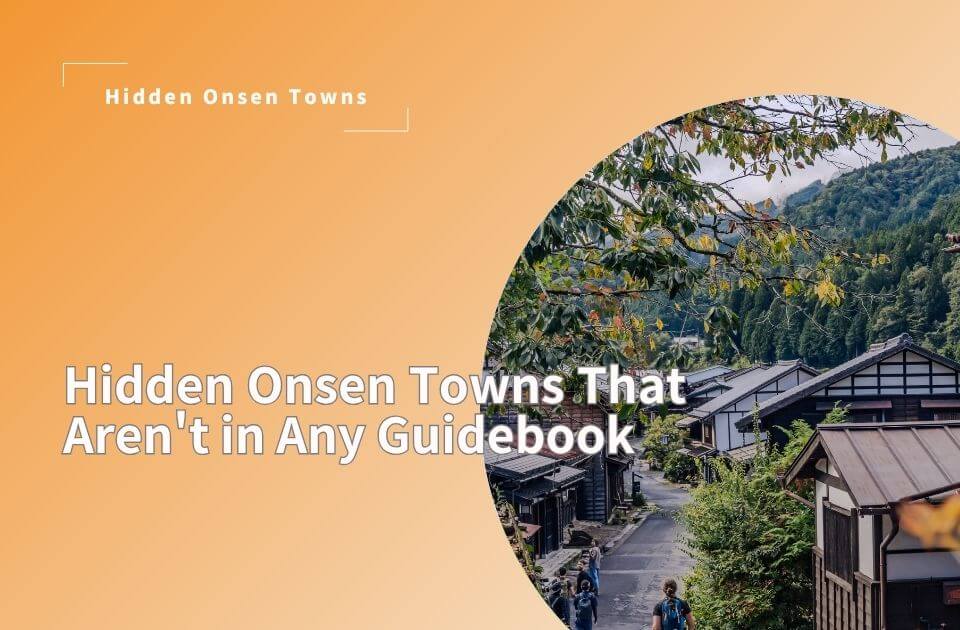
I need to be upfront about something: the moment I publish this article, these places become slightly less hidden. That is the paradox of writing about secret spots. But these onsen towns are so far off the beaten path and so resistant to mass tourism by their very nature that I think they can handle a few more visitors. Besides, every one of them could use the support.
These are not Hakone or Beppu. You will not find these in the top ten results on any major English-language travel site. Some of them require multiple train transfers and a bus that runs three times a day. That is exactly the point. The harder an onsen town is to reach, the more likely it is to feel like the Japan you imagined before you arrived: wooden buildings, steam rising from the street, locals in yukata and geta sandals shuffling between baths, and absolutely nobody asking if you need a selfie stick.
Tsurunoyu Onsen, Nyuto Onsenkyo, Akita Prefecture
Nyuto Onsenkyo is a collection of seven rustic onsen lodges deep in the mountains near Lake Tazawa in Akita. Among them, Tsurunoyu is the most famous within Japan but remains virtually unknown to foreign visitors. The name means “crane’s hot water,” and the legend says that a wounded crane was seen healing itself in the spring centuries ago.
The milky white outdoor bath, surrounded by nothing but forest and sky, is one of the most photographed onsen in Japan for Japanese travel magazines. It is a konyoku (mixed bathing) outdoor bath, which means men and women share the same pool. Before you panic: there is a separate women-only outdoor bath as well, and the milky water provides more modesty than you might expect.
Staying overnight at Tsurunoyu costs about 10,000 to 15,000 yen per person with dinner and breakfast. The rooms are in thatched-roof buildings that feel like stepping back 200 years. Dinner is a hearty mountain meal cooked over an irori (sunken hearth) featuring local mushrooms, mountain vegetables, river fish, and the regional specialty kiritanpo.
Getting there: take the Akita Shinkansen to Tazawako Station, then a local bus to Nyuto Onsenkyo (about 45 minutes, about 800 yen). The bus runs only a few times daily, so check schedules. Book the ryokan well in advance, especially for weekends.
Kurokawa Onsen, Kumamoto Prefecture
Kurokawa Onsen is a tiny hot spring village tucked into a forested ravine in the mountains of Kumamoto, Kyushu. What makes it special is the rotenburo meguri system: for 1,300 yen, you buy a wooden pass (called a nyuyoku tegata) that allows you to try any three of the village’s 28 outdoor baths at different ryokan. This means you can spend an entire day wandering between baths, each with different water properties and atmospheres.
The village itself is gorgeous, with dark wooden buildings and narrow paths along a stream. There are no convenience stores, no chain restaurants, and no neon signs. At night, the bamboo lanterns along the paths create a scene that feels centuries old.
Accommodation in Kurokawa ranges from about 12,000 to 30,000 yen per person with meals. Yamamizuki is a mid-range ryokan with excellent cave baths for about 15,000 yen per person. For a splurge, Sanga has private open-air baths attached to individual rooms from about 25,000 yen per person.
Access is not easy. The nearest major city is Kumamoto, and from there it is about a 3-hour bus ride (about 2,500 yen). Alternatively, drive from the Aso area (about 1 hour). The difficulty of access is part of what keeps Kurokawa so peaceful.
Hoshi Onsen Chojukan, Gunma Prefecture
Hoshi Onsen is a single ryokan in the mountains of Gunma Prefecture that has been operating since 1875. The main bath, Chojukan, is a wooden cathedral of a bathing hall. Imagine a high-ceilinged wooden room with arched windows letting in natural light, filled with steaming water that flows directly from the source through the bottom of the stone-lined pools. It is mixed bathing, though women have designated hours and a separate bath as well.
The architecture alone is worth the trip. The main building is a registered tangible cultural property, and sleeping in the old wing feels like staying in a living museum. Rates start at about 15,000 to 20,000 yen per person with two meals.
From Tokyo, take the Joetsu Shinkansen to Jomo-Kogen Station (about 75 minutes), then a local bus to Sarugakyo Onsen (about 25 minutes, about 700 yen), and from there a free shuttle to Hoshi Onsen (about 10 minutes, runs a few times daily by reservation). The total journey from central Tokyo is about 2.5 hours.
Tamagoyu, Fukushima Prefecture
Hidden in the mountains of Fukushima’s Adatara area, Tamagoyu (which translates to “egg hot water,” named for the sulfurous smell) is a rustic onsen with some of the most mineral-rich water I have ever soaked in. The outdoor bath sits at the base of a mountain, and the water has a distinctive blue-white color from the high sulfur content. Your skin feels different for days afterward, genuinely softer and smoother.
The ryokan is unpretentious and affordable, with rates from about 8,000 to 12,000 yen per person with meals. The food is simple mountain cooking with rice, miso soup, grilled fish, pickles, and seasonal vegetables. Nothing fancy, everything delicious.
From Tokyo, take the Tohoku Shinkansen to Koriyama (about 80 minutes), then the JR Ban-etsu East Line to Nihonmatsu Station (about 20 minutes), then a bus or taxi to Tamagoyu (about 30 minutes). A taxi from Nihonmatsu costs about 4,000 to 5,000 yen.
Yunomine Onsen, Wakayama Prefecture
Yunomine Onsen is one of the oldest hot springs in Japan, with a history going back over 1,800 years. This tiny village of just a few buildings along a narrow stream is part of the Kumano Kodo pilgrimage route and is a UNESCO World Heritage Site, the only bathing hot spring in the world with that designation.
The star attraction is Tsuboyu, a small natural hot spring pool inside a wooden hut next to the stream. You rent the entire hut privately for 30-minute sessions (800 yen per group). The water is said to change color up to seven times a day depending on conditions. The experience of sitting in this tiny ancient bath, knowing that pilgrims have been doing the exact same thing for over a millennium, is profoundly grounding.
There is also a public bathhouse in the village for 400 yen, and the water along the stream is hot enough that you can cook eggs and vegetables in it. The village shops sell net bags of eggs for about 200 yen that you lower into the hot stream and retrieve 15 minutes later, perfectly cooked.
Getting there: from Shingu (accessible by JR from Osaka, Nagoya, or via the Kumano Kodo trail), take a local bus to Yunomine Onsen (about 60 minutes, about 1,000 yen). Accommodation is limited to a handful of small ryokan, with rates from about 10,000 to 18,000 yen per person with meals. Adumaya Ryokan is a solid choice.
Sukayu Onsen, Aomori Prefecture
Sukayu Onsen sits at nearly 1,000 meters elevation on the flanks of Mount Hakkoda in Aomori. It has been operating since 1684 and is designated a “National Health Resort Hot Spring,” one of a select number of onsen in Japan recognized for their therapeutic properties.
The main bath, called Sennin Buro (Thousand-Person Bath), is a massive wooden hall that looks like it could indeed hold a thousand people. The cypress-wood construction, the steam, and the scale of it make you feel like you have stepped into an Edo-period bathhouse. It is mixed bathing, with designated women-only times.
Day bathing costs 1,000 yen. Overnight stays with meals start at about 9,000 to 12,000 yen per person. The onsen sits in an area that gets some of the heaviest snowfall in Japan, so winter visits mean soaking in outdoor baths surrounded by walls of snow.
From Aomori Station, a JR bus runs to Sukayu Onsen in about 80 minutes (about 1,200 yen). The bus runs several times a day but check the schedule, especially in winter.
Okutama Onsen, Tokyo Prefecture (Yes, Tokyo)
I include this one because people never believe me when I say there is a legitimate onsen town within Tokyo Prefecture. Okutama is the westernmost municipality of Tokyo, deep in the mountains about two hours from Shinjuku by JR Chuo Line and Ome Line trains (about 1,100 yen).
Moegi-no-Yu is the main public onsen facility, perched above the Tama River with outdoor baths looking out over the forested valley. Admission is 880 yen for three hours. The water is a simple alkaline spring, good for the skin, and the setting feels a world away from the skyscrapers you left behind that morning.
The area around Okutama is also great for hiking and river activities. The Mukashi Michi (Old Road) trail from Okutama Station to Lake Okutama is an easy two-hour walk that passes through abandoned villages and along old railway tracks. Combine it with an afternoon soak and you have one of the best day trips from central Tokyo that almost no tourist ever does.
Onsen Etiquette Reminders
The rules are simple and the same everywhere: wash thoroughly at the shower stations before entering any bath. Do not put your towel in the water (fold it and place it on your head or on the side of the bath). Enter the water slowly and quietly. Do not swim, splash, or submerge your head. Many traditional onsen do not allow tattoos, though this is slowly changing, especially at smaller rural places. If you have tattoos, call ahead to check, or look for “tattoo-friendly” onsen.
One thing specific to these remote onsen: some of the mixed-bathing pools can feel intimidating, especially for women. If this concerns you, prioritize times with gender-separated access or choose ryokan with private baths. More and more rural onsen are adding women-only hours and separate facilities in response to changing preferences.
Why Bother Going So Far?
I know what you are thinking: that is a lot of train transfers for a bath. But here is the thing. The journey is part of it. By the time you arrive at a remote onsen after two hours of increasingly scenic train and bus rides, watching the landscape transform from city to suburb to forest to mountain, you have already begun to decompress. The onsen is not just the bath. It is the entire process of leaving everything behind and arriving somewhere that time forgot.
These places are treasures. They will not last forever in their current form; rural Japan is aging and depopulating, and every year a few more of these old ryokan close their doors. Go while they are still there. Soak in water that has been heating in the earth for thousands of years. Sleep in a room where the floor creaks and the futon smells like sun-dried cotton. Eat dinner by the light of paper lanterns. This is Japan at its most honest.
Pick one. Go. Soak. You will not regret it.
Follow Japan is your insider guide to experiencing Japan like a local. Follow @followjapan_fj on Instagram for daily Japan travel tips and hidden gems.


